Supporting and normalizing the
Post-Partum
“We speak a lot about the baby blues but it’s time we help you live the
baby bliss!”
In order to understand the approach behind
Post Natal Bliss
it is important for me to tell you a little more about my vision of the postpartum, and why postnatal support is something that is close to my heart.
-
That feeling of happiness, ecstasy, fulfillment...
That feeling you get when you look into your child's eyes!
-
Literally, postpartum refers to the period following childbirth.
While it primarily affects the body of the mother who carried the child, it encompasses much more than just the physical aspect: it is a phase rich in psychological, emotional, and relational dimensions, which also affects the co-parent and the entire family unit.
I am always struck by the confusion between postpartum and postpartum depression—a confusion that reveals the lack of recognition and understanding of this period in our collective consciousness.
It is essential to distinguish between postpartum—which is a period—and postpartum depression, which is a potentially pathological condition that can occur at this time. You don't go through postpartum, you experience it.
Postpartum is the moment when you become a parent, when you meet your baby. It is when reality takes over after months of projections. This transition, often considered to be reserved for mothers, is in fact shared: fathers too, experience their own postpartum period.
It has no fixed duration: its timing is personal, specific to each individual's experience. However, two main phases can be distinguished:
The immediate postpartum period, in the first few weeks after birth, focused on the mother's physical recovery and the formation of the first emotional bonds.
The long postpartum period, which is more subjective and can last several years. It affects the emotional, identity, and psychological aspects of adjusting to this new life as a parent.
-
After pregnancy, whose gestation process is well known, named, understood, and celebrated, begins a process that is less discussed and understood: degestation. Until recently, there was no term to describe the complex physiological changes that occur postpartum. Ingrid Bayot, whose training has greatly enriched me, proposed the term degestation to refer to this essential but often overlooked phase.
These transformations affect several systems: respiratory, cardiovascular, hepatobiliary, ligamentous, renal, cutaneous, etc. It is a long and complex process that is very often reduced to the uterus, which must return to its initial size. Unlike gestation, which mobilizes resources for nine months to support fetal development, degestation involves the involution and deconstruction of the structures put in place during pregnancy. This takes time, several weeks or months depending on the system, and requires patience, kindness, and rest for the mother.
It is a journey toward a new physiological balance for the mother.
-
The term “post-gestation” describes the newborn's significant dependence on caregivers to ensure its physical, emotional, and relational well-being. This dependence requires close proximity and attention from parents. It is as if the newborn was continuing a form of gestation outside the womb.
The mother is no longer pregnant and the baby is no longer a fetus, but both are in a physiological transition, their bodies moving towards a new balance... The “fourth trimester of pregnancy.”
Fortunately, nature is well designed... The newborn's physiological needs for transnatal sensory continuity and the mother's physiological needs for involution facilitate each other. Proximity to the baby will have a chemical effect on the mother (and father!), allowing the secretion of hormones that facilitate protective maternal/paternal behavior.
But this requires slowing down and allowing the mother (as a priority at first, but the father as well) to experience this closeness serenely and with kindness.
-
To name something is to bring it into existence.
It is by putting a word to a reality that we give it form, recognize it, and open up the possibility of sharing it.
When a process, a difficulty, or an emotion cannot be named, it becomes difficult to express. And this silence can isolate—especially among new parents.
Without words, it becomes more complicated to make oneself understood, to ask for help, and above all to feel legitimate in what one is experiencing.
It is also, as Ingrid Bayot so aptly puts it:
“To name is to bring into existence... To name is to allow sharing with others.”
-
Postnatal support aims to assist new parents with their needs, questions, and challenges.
Its objectives are to:
Break the isolation that some mothers, fathers, and couples may feel.
Encourage parents in their role and help them gain confidence.
Offer caring support tailored to each situation.
This is not medical support, but genuine additional support to help parents navigate this new chapter of parenthood, which is full of surprises and twists and turns.

Through Post-Natal Bliss
I hope to contribute to raising awareness of the richness and complexity of the postpartum period.
To offer informed, caring, and tailored support. To help new parents de-dramatize and de-guiltify, while encouraging them in their parenting. The goal is to enable parents to live this period to the fullest, with serenity and confidence.
Although it is often trivialized, it is not normal for childbirth to cause postpartum depression in 20% of women and severe baby blues in 70% of mothers who give birth. These figures are overwhelming, and it is high time to change the situation.
It is high time to help you experience Baby Bliss! That feeling of bliss, ecstasy, and fulfillment that welcoming a newborn should bring.
Some information about me and my background...
Hello!
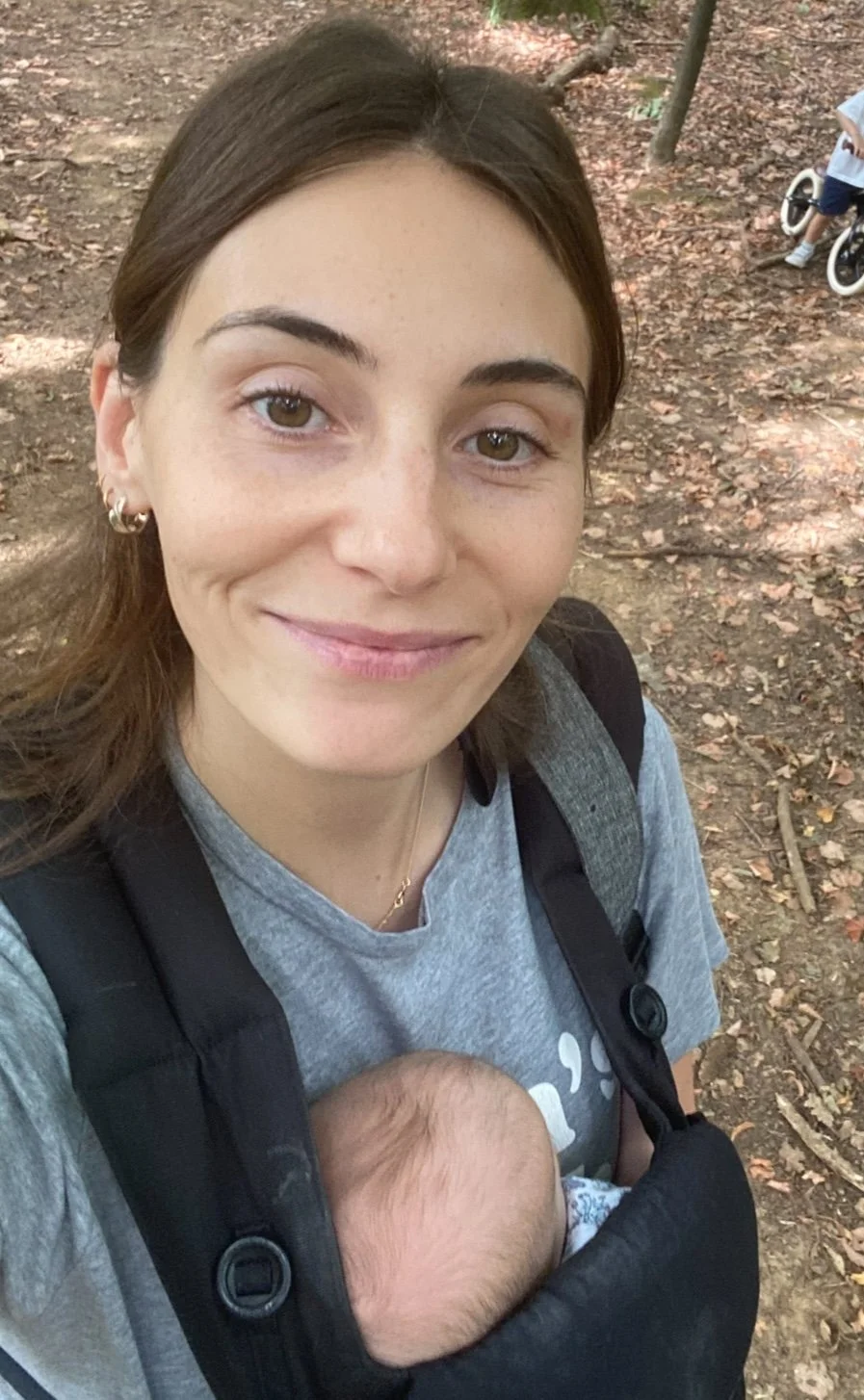
My name is Julie, I am 32 years old and I am the mother of two.
I have always been fascinated by the human mind: how we perceive, think, learn, memorize, make decisions... and how these elements influence our interactions with our environment. But I am also fascinated by human relationships, which are so complex and rich. That's why I naturally gravitated towards a bachelor's degree in Cognitive Sciences and then Psychology during my studies.
I worked for several years with adults with mental disabilities. The birth of my children during the pandemic was a turning point. I decided to take a career break, and when the time came to return to work, I wanted to continue my commitment to support people in their everyday life, but this time with parents.
My personal experience, as well as that of those around me, made me realize a reality:
We often neglect the postnatal period...
We focus on childbirth, as if it were an end in itself.
But childbirth is only the beginning!
It is a moment that profoundly changes our world.
However, support at this time is often insufficient, leaving new parents with questions, doubts, and uncertainties, and few places or professionals to turn to if the issue is not purely medical.
This is what prompted me to train: to support new parents by taking into account all the specificities of the postpartum period.
Understanding the physiology of pregnancy, childbirth, and breastfeeding has convinced me that it is possible to experience this period differently—with respect, kindness, and serenity, far from a purely medical or pathological approach. The postpartum period is a major transition for the mother, baby, and family, which deserves to be supported with gentleness and humanity.
My goal is to offer a space dedicated to the postpartum period, focused on support, listening, and connection, to fully experience this transition.
So I took the time to train...
I started with OhMamaCare's postnatal support training, then I took their training course to become a sleep consultant for children aged 0 to 6. These courses were extremely enriching and taught me a great deal.
At the same time, I took courses with Ingrid Bayot (the fourth trimester of pregnancy, infant sleep, parenting support, and breastfeeding), which completely changed many of my ideas about motherhood thanks to her anthropological and holistic approach.
I have also just completed Suzanne Colson's breastfeeding training course, entitled “Biological Nurturing, Instinctive Breastfeeding.” This approach was also fascinating and inspiring, offering a new perspective on breastfeeding that goes far beyond the transfer of milk. Above all, it was a powerful reminder that we must take an interest in physiology and RESPECT it for the well-being of both mother and baby.
Today, I feel ready to support you, with a solid foundation. My approach aims to support not only the mother, but also the co-parent and the whole family, as each member plays an essential role in this transition. I am convinced that caring, tailored, and comprehensive support can make a real difference.
I look forward to sharing this wonderful adventure with you and seeing you flourish in your parenthood...
Bliss in your eyes!